
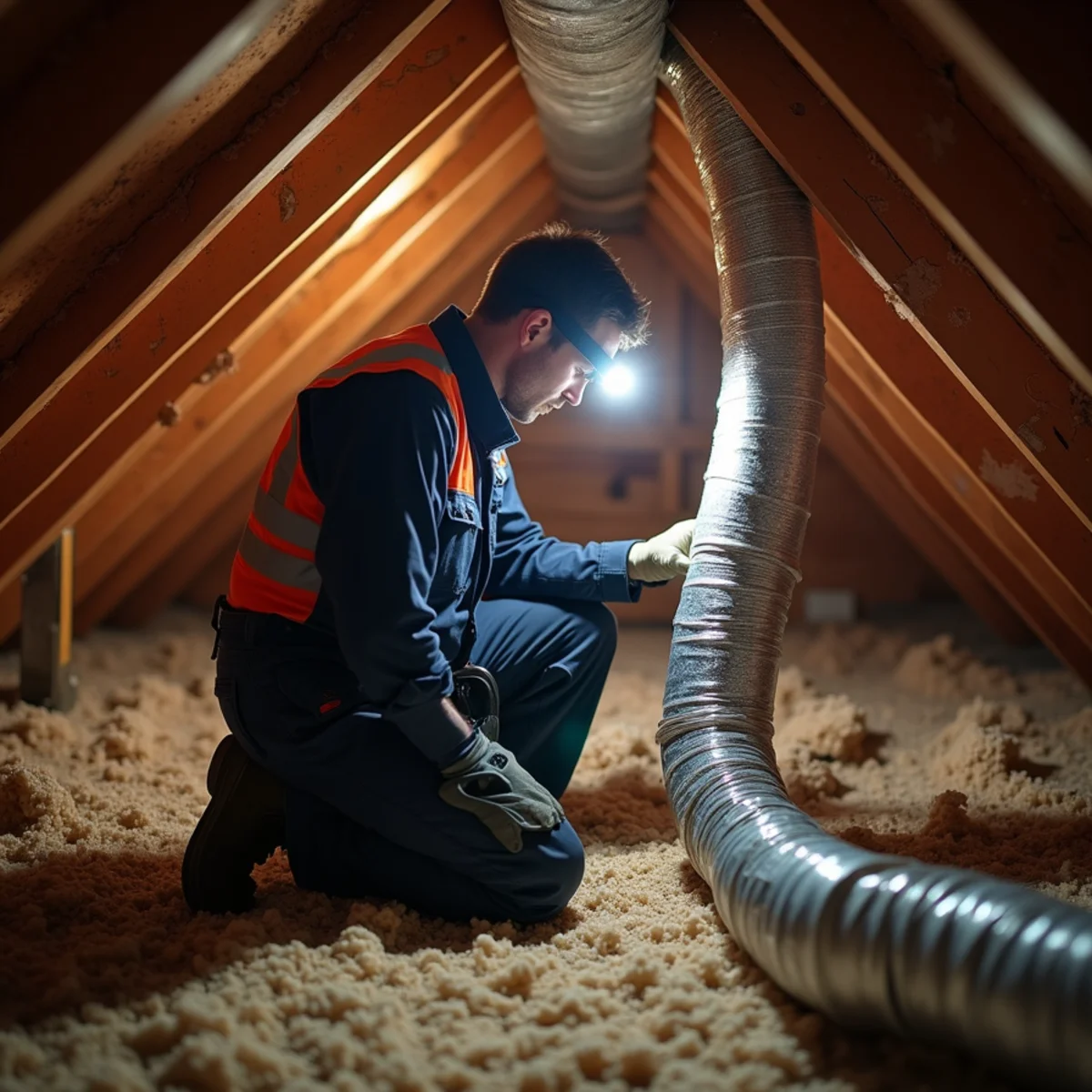
Signs of a ductwork problem
Duct problems hide because you cannot see them. The symptoms are what you notice: a back bedroom that is always hot while the living room is freezing, a house that feels sticky even when the thermostat is satisfied, a system that runs non-stop, dust that comes back a day after cleaning, or ductwork you can see sweating in the attic. In homes this age, those are duct symptoms far more often than equipment symptoms.
- One or more rooms never reach temperature
- The house feels humid with the AC running
- High bills and a system that runs constantly
- Visible sweating or wet insulation on attic ducts
- Rooms that are dusty again right after cleaning
Original ducts in 1960s to 1980s Orange Park homes: duct board, grey flex and sheet metal
With a median build year of 1974, a lot of Orange Park ductwork is original — duct board that has delaminated, the old grey flex that gets brittle and tears, or sheet metal with joints that have worked loose over decades. Any of it can be leaking a quarter or more of your conditioned air straight into a 130-degree attic.
We inspect what you actually have, where it is losing air, and whether the honest answer is a targeted repair, a full seal, or replacement of the worst runs.
Need an HVAC technician now?
We answer live 24/7 and give you a price before any work starts.
Sweating ducts, wet insulation and mold in a Florida attic
When a cold duct runs through a hot, humid attic and its insulation has failed, the surface drops below the dew point and condensation forms — the duct "sweats." That water soaks insulation, stains ceilings, and creates exactly the damp, dark conditions mold likes. It is a moisture problem disguised as a leak.
The fix is restoring the duct's insulation and vapor barrier and correcting the airflow, not just wiping up the water. We also flag when water or mold damage warrants a specialist beyond the HVAC scope.
Hot back bedrooms and weak airflow: undersized returns and crushed runs
A room that will not cool is usually starved for air. The supply run may be crushed, kinked, or disconnected in the attic, or — very common in older homes — the return air is undersized, so the system cannot move enough air to balance the house. Closing vents elsewhere rarely fixes it and can make the pressure problem worse.
We measure airflow room by room, find the restriction, and correct the run or the return instead of blaming the equipment.
Need an HVAC technician now?
We answer live 24/7 and give you a price before any work starts.
Duct sealing, repair or full replacement: how to choose
Not every duct problem needs a full replacement. Sealing leaky joints and connections is often the highest-value fix. A damaged section of flex can be replaced on its own. But when duct board is crumbling throughout the attic or flex is brittle and torn across the whole system, repairing one piece at a time costs more over time than replacing the runs.
We give you the straight version: what sealing will buy you, what needs replacing, and what each path does for comfort, humidity and your bill.
House feels sticky with the AC on: oversized units, fan settings and dehumidifiers
A home can hit its temperature and still feel clammy because the air is too humid. The biggest culprit is an oversized system that cools fast and shuts off before it pulls moisture out of the air. Running the fan on "on" instead of "auto" can also re-evaporate moisture off the coil back into the house. And in a tight or shaded home, a whole-home dehumidifier may be the right tool.
We diagnose why the house is humid — sizing, airflow, duct leaks, fan setting, or drainage — before recommending anything, because the fix is different for each.
Need an HVAC technician now?
We answer live 24/7 and give you a price before any work starts.
Filtration and UV lights: what helps and what does not
Indoor air add-ons are useful in the right situation and oversold in the wrong one. A better filter helps — but only if it is matched to the system's airflow, since a too-restrictive filter can freeze the coil. A UV light can help keep a coil clean. Neither one fixes leaky ducts, poor sizing, or a moisture source, and we will not sell one as if it does.
We start with the source of the complaint — airflow, moisture, duct condition, coil cleanliness — and recommend an add-on only when it actually addresses the problem you have.

Our ductwork repair and humidity control process in Orange Park
- 1
Comfort and airflow assessment
We measure room-by-room airflow and indoor humidity to find whether the problem is duct leaks, sizing, undersized returns or the equipment.
- 2
Attic and duct inspection
The technician inspects the duct board, flex and connections in the attic, looking for leaks, crushed runs, failed insulation and sweating.
- 3
Written options
You get the findings and a written scope — seal, repair a section, or replace runs — with what each option buys you in comfort and humidity.
- 4
The work
We seal joints and connections, replace damaged runs, restore insulation and vapor barrier, and correct undersized returns where needed.
- 5
Verify the fix
We re-check airflow and humidity so the hot back bedroom and the sticky feeling are actually resolved, not just addressed on paper.
Why Orange Park homeowners choose us for ductwork repair and humidity control
We find the real cause of hot rooms
A room that will not cool is usually a duct or return problem, not the thermostat — we measure instead of guess.
Humidity, not just temperature
We diagnose the moisture problem behind a clammy house: sizing, duct leaks, fan settings or drainage.
Honest seal-vs-replace advice
Sometimes sealing is the high-value fix; sometimes replacement is. We tell you which, with the reasons.
Add-ons only when they help
We recommend a dehumidifier, filter or UV light only when it addresses the problem you actually have.
Licensed, insured Florida contractors
Attic and duct work is done by licensed, insured HVAC pros.
What affects the cost of ductwork repair and humidity control
We never quote a price before diagnosing the system. These are the factors that shape it — and you always get the number in writing before any work starts.
- Sealing versus repairing a section versus replacing whole runs
- How much of the duct system is affected and how accessible the attic is
- Restoring insulation and vapor barrier on sweating ducts
- Adding or resizing return air
- Whether a dehumidifier or air-quality component is part of the solution
Where we provide ductwork repair and humidity control
We repair ductwork and solve humidity across Orange Park and Clay County. Green Cove Springs' older homes near Spring Park often have central air retrofitted into tight spaces, and Oakleaf and Fleming Island attics run hot enough to degrade duct insulation — all of it feeds comfort complaints and replacement work.
Ductwork & Humidity — frequently asked questions
Still have a question? Just call.
A licensed HVAC technician can answer it and, if needed, be on the way. 24/7.